Technical skills open the door to the IT industry. But it's soft skills that shape the trajectory of your career.
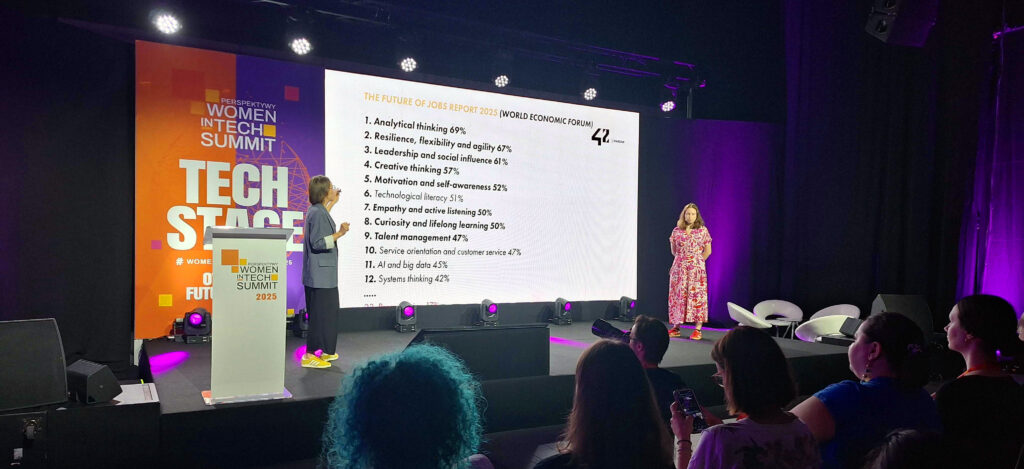
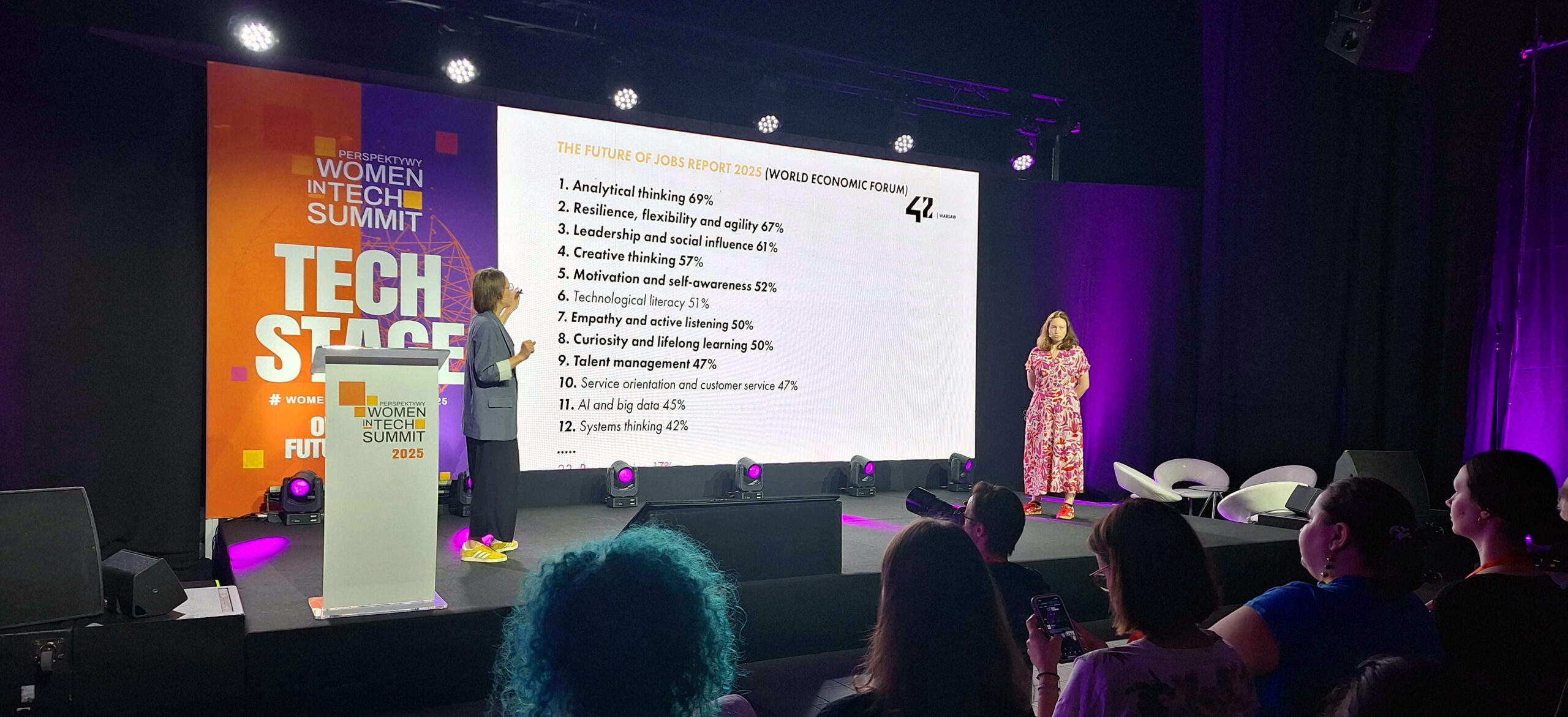
That’s the argument we made on stage at Women in Tech Summit. And the data from the World Economic Forum backs it up.
What does the IT job market actually look for?
According to the latest World Economic Forum report the most in-demand skills of the future are largely non-technical. At the top of the list: eight so-called power skills, including analytical thinking, resilience, adaptability, leadership, and creativity.
This shift isn’t accidental. Tools like GitHub Copilot and ChatGPT can already generate code, solve technical problems, and suggest solutions, often faster than a junior developer. That’s one reason why breaking into IT without real-world experience is becoming increasingly difficult.
But there’s something AI can’t do. It doesn’t understand emotional context. It can’t hold a meaningful conversation with a client. It can’t design a solution that accounts for human needs and team dynamics. It won’t take responsibility for cybersecurity decisions – or for anything that requires empathy and a deeper understanding of people.
And that’s precisely where human advantage lies. Especially in an industry that, until recently, valued code above all else.
soft Skills you build at 42 Warsaw
At Women in Tech Summit 2025, Aleksandra Czetwertyńska, Director of 42 Warsaw, and Iga Skolimowska, Partnerships Manager, explained how the methodology used daily across the 42 school network builds soft skills. And why this is an integral part of technical education, not an add-on.
As Iga Skolimowska put it: “You can’t graduate from 42 without talking to other people, because all your projects have to be evaluated by fellow students.”
The 42 Warsaw pedagogical model embeds power skills directly into the learning structure. No teachers, no fixed schedule, no traditional classes – from day one, students take full ownership of their progress and projects.
Here are the key skills you develop at 42 Warsaw every day:
Communication and feedback
Built into the process through mandatory peer evaluations. You learn to clearly explain your design decisions, defend your technical choices, and both give and receive constructive feedback.
Collaboration
Working constantly with others on complex problems makes teamwork your default mode. You learn to bring together different perspectives, navigate disagreements, and reach solutions as a group.
Critical and analytical thinking
Developed through independent research, fact-checking, and tackling problems that don’t have a single right answer.
Accountability and self-organisation
No one tells you what to do or when. You take full responsibility for your learning path, project delivery, and time management. It’s challenging and that’s exactly why it works.
Problem-solving under pressure
Every task has multiple possible solutions and often demands quick adaptation. These are exactly the conditions you’ll face in a real job.
Resilience and learning from failure
At 42 Warsaw, failure is part of the process, not something to be ashamed of. There’s no penalty system, so students are free to make mistakes, which encourages experimentation.
Can power skills be learned?
Yes. Power skills aren’t innate traits. They can be developed through daily practice — as long as you’re in the right environment. That’s why both the 42 Warsaw methodology and campus are designed to help students grow on two levels at once: human and technical. That’s the only combination that makes sense today.
Watch the full talk by Aleksandra and Iga on YouTube.