
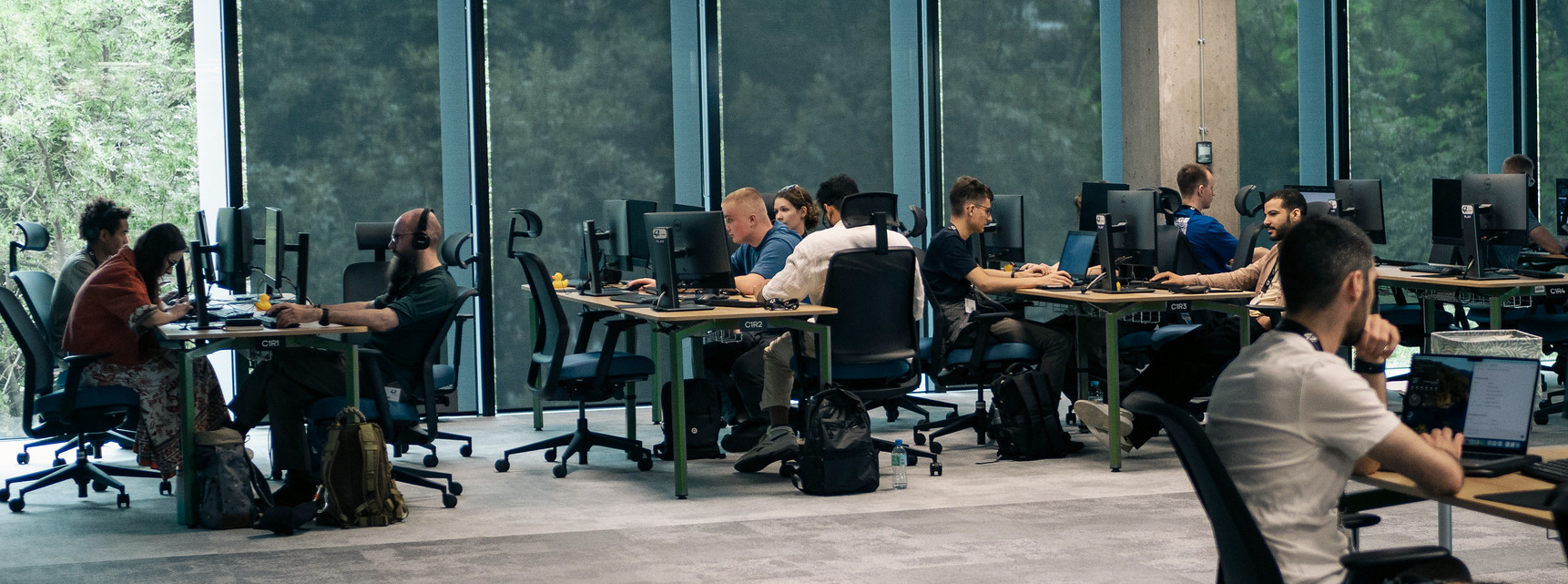
The 42 Warsaw curriculum is an intensive journey into the heart of computer science, divided into two parts: the Core Curriculum and Specializations.
The Core Curriculum, starting with C and Python, is designed to develop not only coding skills but also critical thinking and the ability to adapt to new challenges.
After completing this stage, you move on to your chosen Specializations, which include over 100 projects. Fields like AI, mobile or web development, cybersecurity – or any combination of these – are at your fingertips.
You won’t get step-by-step instructions – each project is an open-ended problem to solve with code, and there’s always more than one way to do it.
CORE CURRICULUM MODULES
The Common Core is structured into 7 thematic modules, each containing multiple hands-on projects.
You’ll progress through these modules at your own pace, building a comprehensive skill set
that prepares you for professional software development.
Programming Fundamentals
- In the Programming Fundamentals module, you will master the art of C programming from the ground up, learning to build your own tools and libraries while understanding how memory really works.
- You will explore string manipulation, dynamic allocation, file I/O, and algorithmic problem-solving, developing the foundational skills that every great programmer needs.
- By the end, you will think like a computer and write code that is both elegant and efficient.
Object Oriented Programming
- In the Object-Oriented Programming module, you will dive deep into Python and master the principles of modern software design, learning to build elegant, maintainable applications using classes, inheritance, and design patterns.
- You will explore data manipulation, visualization, functional programming paradigms, and game development, creating interactive projects that bring your code to life.
- By the end, you will think in objects and architect solutions that are both powerful and pythonic.
Web
- In the Web module, you will enter the dynamic world of modern web development, learning to build full-stack applications that combine beautiful interfaces, robust back-end services, and real-time communication.
- You will master front-end technologies, API design, database management, authentication systems, and containerized deployment, creating engaging web experiences that users love.
- By the end, you will build complete, production-ready applications that solve real-world problems with style and security.
System and Network Programming
- In the System and Network Programming module, you’ll learn to create concurrent and distributed applications that handle multiple tasks simultaneously and communicate smoothly across networks.
- You will master multithreading, synchronization, resource management, and network protocol design, learning to build high-performance apps that use multi-core processors.
- By the end, you will build robust, scalable systems that coordinate effortlessly in distributed environments.
Artificial Intelligence
- In the Artificial Intelligence module, you will unlock the transformative power of Large Language Models, learning to build intelligent applications that understand, retrieve, and generate information with unprecedented capability.
- You will master prompt engineering, Retrieval-Augmented Generation (RAG), and agentic AI systems, discovering how to create autonomous applications that reason, plan, and interact with their environment.
- By the end, you will architect AI-powered solutions that push the boundaries of what’s possible with modern language models.
Algorithmics
- In the Algorithmics module, you will develop the mindset of a problem solver, learning to design elegant algorithms that balance efficiency with resource constraints.
- You will explore optimization strategies, graph traversal, multi-agent pathfinding, and system simulation, mastering the art of analyzing complexity and choosing the right approach for each challenge.
- By the end, you will tackle computational problems with confidence and creativity.
Administration System
- In the Administration System module, you will step into the role of a system administrator, learning to build, secure, and manage server infrastructure from scratch.
- You will master virtualization, networking fundamentals, and modern containerization technologies, gaining the power to deploy and orchestrate complex multi-service applications.
- By the end, you will possess the skills to manage modern infrastructure with confidence and efficiency.
EXTRAS: more than coding
At 42 Warsaw, it’s not just WHAT you learn. Your learning path is shaped by the community and environment around. Beyond the core curriculum, we run parallel activities that make the on-campus experience truly complete:
- Connecting students with interesting internship opportunities.
- Meetups & AMAs with tech experts (from companies such as PLAY, InPost, Allegro, Webellian, iteo, SAIO, among others), sharing first-hand insights, experiences, and networking opportunities.
- Mentoring program offering guidance, advice, and support from experienced professionals.
WHAT WILL YOU MASTER?
- Design and implement robust server infrastructures using Docker.
- Develop secure network protocols and applications that ensure data integrity.
- Create dynamic web applications with responsive design and real-time capabilities.
- Engineer complex algorithms to solve diverse computational problems efficiently.
- Automate system administration tasks through scripting and tool development.
- Craft intelligent AI solutions, including chatbots and recommendation engines.
- Build scalable applications capable of handling high user demand in cloud environments.
- Optimize application performance through rigorous testing and refactoring.
- Lead collaborative projects, harnessing peer feedback to refine solutions.
- Demonstrate resilience and adaptability in fast-paced, evolving tech scenarios.
- Communicate complex technical concepts clearly to diverse audiences.
- Exhibit a continuous learning mindset, staying abreast of industry trends.
SPECIALIZATIONS
The second part of the curriculum is the specialization, where learners get to decide which direction they want to move forward in: fields such as AI, mobile or web development, cybersecurity, or a combination of these fields are at your disposal – and more.
This program includes over 100 projects to complete in groups, and also features internships and entrepreneurial programs.
life after 42
42 Warsaw graduates are ready for a variety of roles in the tech industry: Front-End Developer, Back-End Developer, Full-Stack Developer, Mobile Application Developer, DevOps Engineer, Data Scientist, AI / Machine Learning Engineer, Cybersecurity Specialist, Game Developer, Blockchain Developer, Cloud Engineer, Systems Architect, Network Engineer, Database Administrator, Software Tester, IT Project Manager, UX/UI Designer, Technical Support Specialist, IT Consultant, Technical Writer.
These are examples, not limits.
Q&A
It depends on your pace. Studying around 25 hours/week usually takes 18-24 months, while full-time students (50+ hours/week) have finished in under 10 months. The campus is open 24/7, so you decide when to code.
No. You don’t need any prior coding experience or a technical background to apply. The program is designed for beginners as well as people who already have some knowledge. What matters most is motivation, problem-solving skills, and willingness to learn.
Learning at 42 is built around collaboration and peer-to-peer support. All those spontaneous moments when you meet others, exchange ideas, and learn together. Campus events and meetups also give you great opportunities to expand your skills and network with companies. So… technically yes, but trust us: you’ll get the most out of 42 by being on campus.
Yes. 42 Warsaw covers all tuition. You won’t pay anything before, during, or after the program. 42 schools worldwide are 100% free, nonprofit, and open to anyone with talent and motivation. You’ll only need to cover your own living expenses in Warsaw, as the program is full-time and in person.
